
Gastronomy education at MIUN thanks to collaboration with Italy’s Parma
Wilhelm Skoglund is a lecturer at Mid Sweden University and teaches, among other things, social entrepreneurship. He is also one of the dedicated enthusiasts who were involved from the very beginning, when Östersund and Region Jämtland Härjedalen applied to become a UNESCO Creative City of Gastronomy.
When the designation became a reality, Wille and his colleagues worked to create a research platform together with the network’s other member cities. This resulted in a research conference in 2016, held in conjunction with Östersund hosting UCCN’s annual meeting. Around 100 international delegates took part in the research conference, and many new contacts were made.
– During the conference, we met some representatives from the University of Parma, Italy. We talked about the need for university education in sustainable gastronomy, and that it could be shared by the cities in the network. Several of us continued working on the programme plans, and over time we also brought in the universities in Bergen and Alicante.
It took a few years to turn the idea into reality, but in 2020 the universities were finally able to offer the one-year master’s programme Food City Design for the first time. It is a broad programme covering everything from nutrition and cultivation to marketing—all with a sustainability perspective. The aim is for students to be able to work with food, procurement, supply and sustainable food production in the public sector or in large companies—and contribute to greater awareness in society.
– After the first cohort, we have had time for another. About 20 students have been admitted each year, and in total 5–6 have been from Sweden. It is an incredibly exciting mix of people, with completely different backgrounds: chefs, tourism scholars, hotel managers, economists… The idea was for teaching to take place in Östersund for one term and in Parma for one term, but the pandemic put a stop to that and large parts of the programme became digital.
Martin got a job at
Eldrimner after the programme
One of those who studied Food City Design is Martin Jaller. He already had a bachelor’s degree in experience production, is a trained chef, and has also worked in events, TV and hotels.
– I wanted to find a way to combine my academic background, my work experience and my chef training—so that in the long term I could work more strategically. What I take with me most of all from the programme is the cultural exchange, how different countries view food, and the deeper knowledge I gained about Agenda 2030. I realised that creativity and innovation are also required in food production if we are to succeed in reaching the global goals.
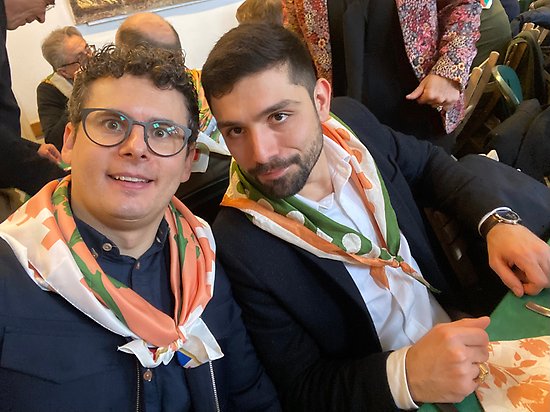
Martin Jaller and his Italian classmate Alberto Laschi at graduation in Parma.
One of those who studied Food City Design is Martin Jaller. He already had a bachelor’s degree in experience production, is a trained chef, and has also worked in events, TV and hotels.
– I wanted to find a way to combine my academic background, my work experience and my chef training—so that in the long term I could work more strategically. What I take with me most of all from the programme is the cultural exchange, how different countries view food, and the deeper knowledge I gained about Agenda 2030. I realised that creativity and innovation are also required in food production if we are to succeed in reaching the global goals.
During the programme, Martin did an internship at Eldrimner. He now has a permanent position there and works, among other things, with training and business advisory services.
Wille and his colleagues have now paused the programme to regroup. The goal is a two-year research-preparatory programme with even more depth and breadth, which will hopefully attract even more students.


